I'll be attending PriMed East, one of the largest physician trade shows/conference, tomorrow in Boston. Its usually a great place to catch up with people I've known in medicine through the years, in training and in practice. A highlight of the event is the EMR vendors exhibits, where there's always a very broad representation of vendors. If you're an up and coming EMR or Healthcare IT vendor, this is a great place to showcase your product to regular practicing physicians, the ones that really drive healthcare.
I'll be sure to give a run down of the event next week...
Thursday, October 11, 2007


Wednesday, October 10, 2007
HL7 v3, A Challenge in Implementation
Its been a while since I've written a technical blog entry. HL7 is a favorite topic of mine, especially HL7 v3. Therefore, after reading David Li's piece in NeoTool's blog, Preparing for HL7 V3, I was motivated to give my 2 cents on the topic.
I've spent a lot of time trying to implement a practical HL7 v3 solution. I quickly realized that to use it for messaging would be highly impractical. There are just too many possible interpretations of how to convey a message using the v3 messaging model. A great quote I remember describing HL7 v3's XML structure, was "they used every trick in the book".
What I did find helpful however was the RIM (Reference Information Model) as a health-care data model. Having said that, I would caution against using the HL7 v3 RIM to model a logical relational database design.
RIM can serve as a very useful starting point for a design, but do not use it too literally. Doing so can lead to a very inefficient and needlessly complex database design. As I learned in engineering school, learning where to make trade-offs is the difference between a practical design and an exact, but impractical design.
I've spent a lot of time trying to implement a practical HL7 v3 solution. I quickly realized that to use it for messaging would be highly impractical. There are just too many possible interpretations of how to convey a message using the v3 messaging model. A great quote I remember describing HL7 v3's XML structure, was "they used every trick in the book".
What I did find helpful however was the RIM (Reference Information Model) as a health-care data model. Having said that, I would caution against using the HL7 v3 RIM to model a logical relational database design.
RIM can serve as a very useful starting point for a design, but do not use it too literally. Doing so can lead to a very inefficient and needlessly complex database design. As I learned in engineering school, learning where to make trade-offs is the difference between a practical design and an exact, but impractical design.
Monday, October 8, 2007
Nursing Homes finally getting attention
FierceHealthIT had an interesting commentary piece on IT in the long-term care setting. As a physician who cares for patients in a nursing home, I know first hand, that caring for a patient in a nursing home is extremely challenging.
There is a complete lack of any IT at most nursing homes. Patients frequently come from multiple sources, such as community and tertiary hospitals. Patients bring with them stashes of paper-- labs, radiology reports, discharge summaries etc. Trying to put all the information together to get a complete view of a patient is nearly next to impossible. It is at the nursing homes where IT- RHIOs/HIEs and telemedicine can have a real impact in the quality of care of patients.
I'm happy to see long-term care finally get some attention.
There is a complete lack of any IT at most nursing homes. Patients frequently come from multiple sources, such as community and tertiary hospitals. Patients bring with them stashes of paper-- labs, radiology reports, discharge summaries etc. Trying to put all the information together to get a complete view of a patient is nearly next to impossible. It is at the nursing homes where IT- RHIOs/HIEs and telemedicine can have a real impact in the quality of care of patients.
I'm happy to see long-term care finally get some attention.
Likely PHR users
HealthVault has really stimulated great discussion on the issue of PHRs. A good part of the discussion is on the viability of the PHR concept and if PHRs concept will really "take off".
The vast number of PHR users are likely going to be the "worried well" (hypochondriacs) or those people with chronic illness who like to track (or in some cases, obsess) over their health issues.
The elderly, who probably would have the most to gain from a PHR for its ability to track long medication lists, multiple doctor visits and hospitalizations, are the same people who would be less likely to use a PHR. And this is not just because the elderly are not computer literate, but because of the usual age related health problems, such as low vision, early dementia etc. We will need to depend on the care givers to manage their PHRs.
To most people however, healthcare is something they hire someone else to worry about (the doctor) in much the same way we have a fund manager to manage our mutual funds. I suspect that it will be the “Quicken” types who will make up the vast majority of PHR users.
The vast number of PHR users are likely going to be the "worried well" (hypochondriacs) or those people with chronic illness who like to track (or in some cases, obsess) over their health issues.
The elderly, who probably would have the most to gain from a PHR for its ability to track long medication lists, multiple doctor visits and hospitalizations, are the same people who would be less likely to use a PHR. And this is not just because the elderly are not computer literate, but because of the usual age related health problems, such as low vision, early dementia etc. We will need to depend on the care givers to manage their PHRs.
To most people however, healthcare is something they hire someone else to worry about (the doctor) in much the same way we have a fund manager to manage our mutual funds. I suspect that it will be the “Quicken” types who will make up the vast majority of PHR users.
Sunday, October 7, 2007
Obstacles for PHRs, HealthVault?
From the WSJ article Microsoft's Health Push Faces Obstacles :
" "Consumers are just not that excited about these" services, said Elizabeth Boehm, an analyst at Forrester Research Inc"
"Few households watch their health closely, so they aren't looking for new health tools. "In general they're not tracking it and don't understand the value of having it equally shareable" in digital form, Forrester's Ms. Boehm said. "They just don't understand what's in it for them.""
I must say that I do agree that most patients are not interested in this detailed level of their healthcare. The PHRs are being promoted/marketed to the general population, while products such as EMRs (electronic medical records) are targeted at a smaller group, the physicians. If just 10% of the population adopts PHRs, this may be considered a success from a consumer business standpoint, but will not necessarily revolutionize how healthcare is practiced. Wide-spread physician adoption is still the key to any healthcare revolution.
Unfortunately, those that consume much of the healthcare resources, the elderly and less affluent, may be less likely to use a PHR. Most PHR users likely will be among the better educated and many of these people will be the so called "worry-wells" (patients that are actually health but worry about their own health disproportionately)
" "Consumers are just not that excited about these" services, said Elizabeth Boehm, an analyst at Forrester Research Inc"
"Few households watch their health closely, so they aren't looking for new health tools. "In general they're not tracking it and don't understand the value of having it equally shareable" in digital form, Forrester's Ms. Boehm said. "They just don't understand what's in it for them.""
I must say that I do agree that most patients are not interested in this detailed level of their healthcare. The PHRs are being promoted/marketed to the general population, while products such as EMRs (electronic medical records) are targeted at a smaller group, the physicians. If just 10% of the population adopts PHRs, this may be considered a success from a consumer business standpoint, but will not necessarily revolutionize how healthcare is practiced. Wide-spread physician adoption is still the key to any healthcare revolution.
Unfortunately, those that consume much of the healthcare resources, the elderly and less affluent, may be less likely to use a PHR. Most PHR users likely will be among the better educated and many of these people will be the so called "worry-wells" (patients that are actually health but worry about their own health disproportionately)
Saturday, October 6, 2007
Microsoft HealthVault for storing our data, Issues regarding Privacy and Security
Many are asking, how secure will my data be? Will hackers be able to access it. Well, who knows? Many of us do online banking, and have trust in this process. With my back account, I know every crook around the word would see me as a target. Money has universal value. With my healthcare data however, I doubt someone on the other side of the world would be interested.
The only people that really might have an interest in my health data would be my family, friends, neighbors or co-workers. One can argue that my employer may as well. The real fear however would be if the government or insurance companies get access to my PHR data. If thats the case, they would not do it illegally by hacking (as would a neighbor). I'm afraid this would only happen if we allow a shift in public policy to take place which would permit our PHR data to be accessed by these other entities.
Once there is a sizable PHR database based on our nations population, it will be too tempting for politicians and policy makers not to try to make arguements to justify use of this data for the "public good". As politicians frequently do, they'll say, "we're doing it for the children".
This is the real threat to the privacy of our data.
The only people that really might have an interest in my health data would be my family, friends, neighbors or co-workers. One can argue that my employer may as well. The real fear however would be if the government or insurance companies get access to my PHR data. If thats the case, they would not do it illegally by hacking (as would a neighbor). I'm afraid this would only happen if we allow a shift in public policy to take place which would permit our PHR data to be accessed by these other entities.
Once there is a sizable PHR database based on our nations population, it will be too tempting for politicians and policy makers not to try to make arguements to justify use of this data for the "public good". As politicians frequently do, they'll say, "we're doing it for the children".
This is the real threat to the privacy of our data.
Google's PHR
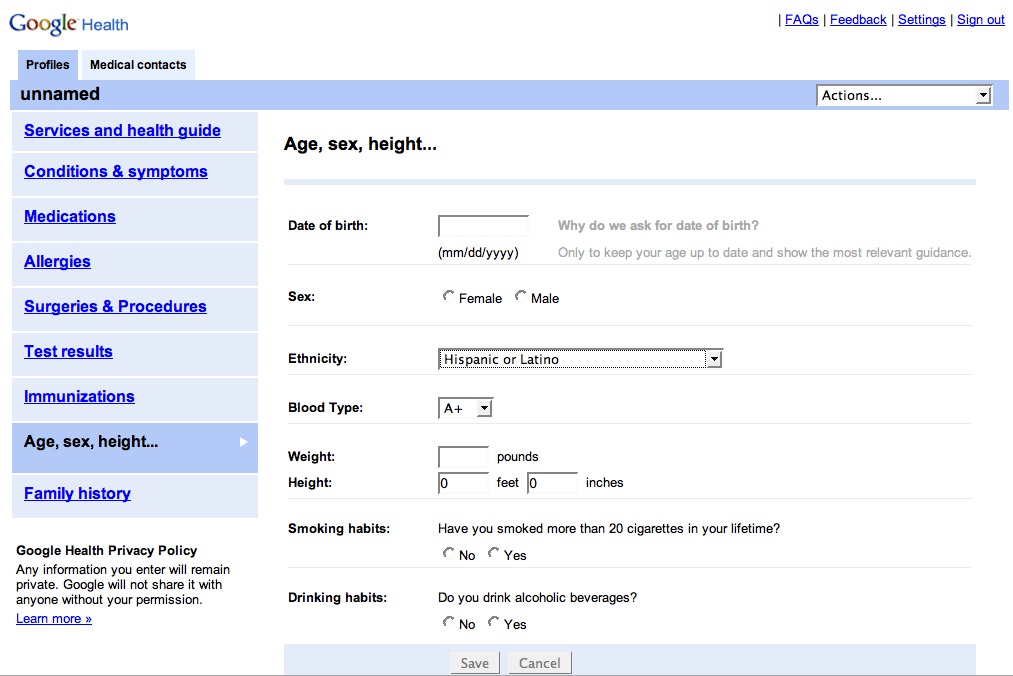 While on the topic of HealthVault and PHRs, the discussion would not be complete without mentioning Google. Here is a link to some screen shots of Google's prototype PHR. This is more of a PHR than Microsoft's Healthvault. My patients and fellow physician colleagues would not have a problem understanding this type of application, its functionality is very obvious. Google's prototype PHR appears to be an "end-product" rather than a set of services like HealthVault.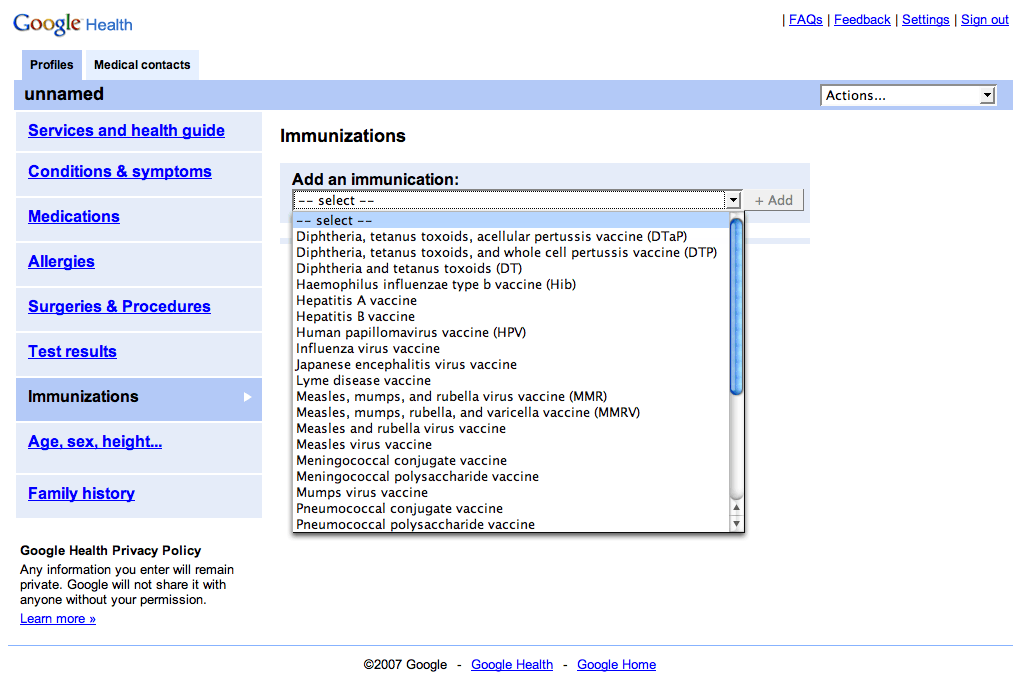

Subscribe to:
Posts (Atom)


