FierceHealthIT had an interesting link to an article on PHR standards development:
Health insurers, HL7 team to create portable PHRs
Its nice to hear that HL7 is developing a PHR standard, however, I wonder if companies like Microsoft (see HealthVault) will the ones to create a de-facto, practical PHR standard that one can actually implement using existing tool sets. From my own experience with HL7 v3, I don't have much confidence that standards committees can put together something that is practical in implementation. See my previous post on HL7 v3 implementation.
Showing posts with label PHR. Show all posts
Showing posts with label PHR. Show all posts
Tuesday, December 11, 2007


Wednesday, November 7, 2007
Yahoo, Google and our Privacy, what's there to fear?
This morning I read:
"...Yahoo chief under fire over Chinese dissident ...". Apparently Yahoo provided personal Email data from a Chinese dissident that led to his imprisonment . It really should make you think about just how much of our personal information is out there and what some of the consequences can be when our privacy is compromised.
And just today, I also just read about the Candid CIO's enthusiasm about Google's new StreetView:
"Only a nerd like me would be excited about this"
"It allows you to see 360 pictures of the streets in Google maps. Google has mostly taken pictures of the streets in big cities."
"Yesterday, Just as I was arriving home from work there was a car with a fancy camera mounted on a pole that extended high above the roof. On the side of the car was a magnetic Google sign."
I don't know about you, but I'd get a bit nervous about having Google or any one else having even more info on me. And to think now that we are too also have them keep our personal health records (PHR). We really need to think this through carefully.
"...Yahoo chief under fire over Chinese dissident ...". Apparently Yahoo provided personal Email data from a Chinese dissident that led to his imprisonment . It really should make you think about just how much of our personal information is out there and what some of the consequences can be when our privacy is compromised.
And just today, I also just read about the Candid CIO's enthusiasm about Google's new StreetView:
"Only a nerd like me would be excited about this"
"It allows you to see 360 pictures of the streets in Google maps. Google has mostly taken pictures of the streets in big cities."
"Yesterday, Just as I was arriving home from work there was a car with a fancy camera mounted on a pole that extended high above the roof. On the side of the car was a magnetic Google sign."
I don't know about you, but I'd get a bit nervous about having Google or any one else having even more info on me. And to think now that we are too also have them keep our personal health records (PHR). We really need to think this through carefully.
Saturday, October 6, 2007
Google's PHR
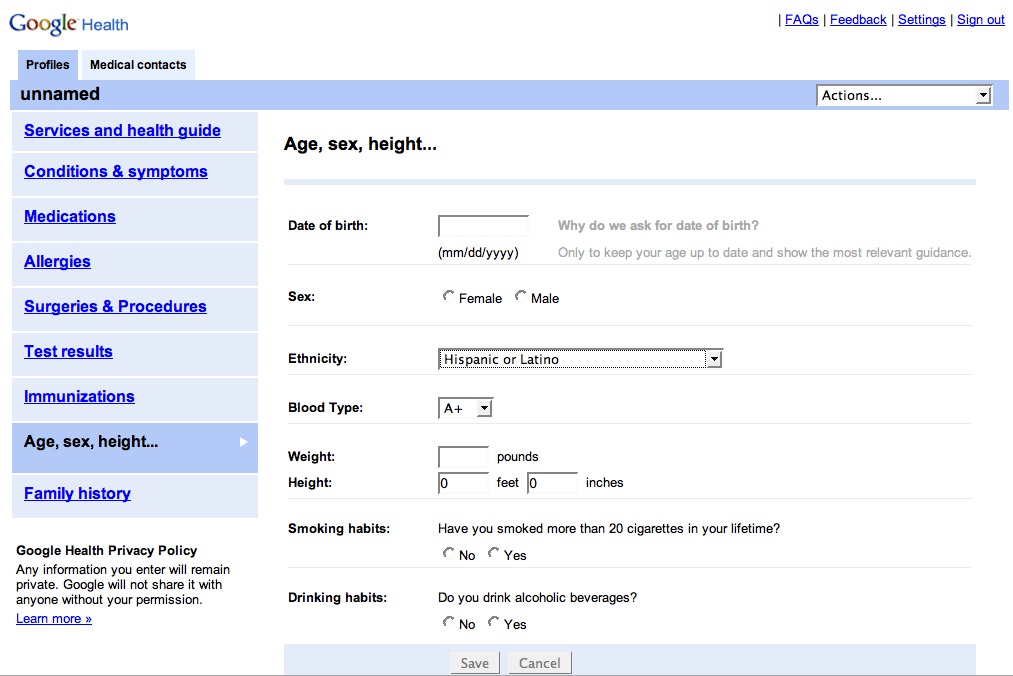 While on the topic of HealthVault and PHRs, the discussion would not be complete without mentioning Google. Here is a link to some screen shots of Google's prototype PHR. This is more of a PHR than Microsoft's Healthvault. My patients and fellow physician colleagues would not have a problem understanding this type of application, its functionality is very obvious. Google's prototype PHR appears to be an "end-product" rather than a set of services like HealthVault.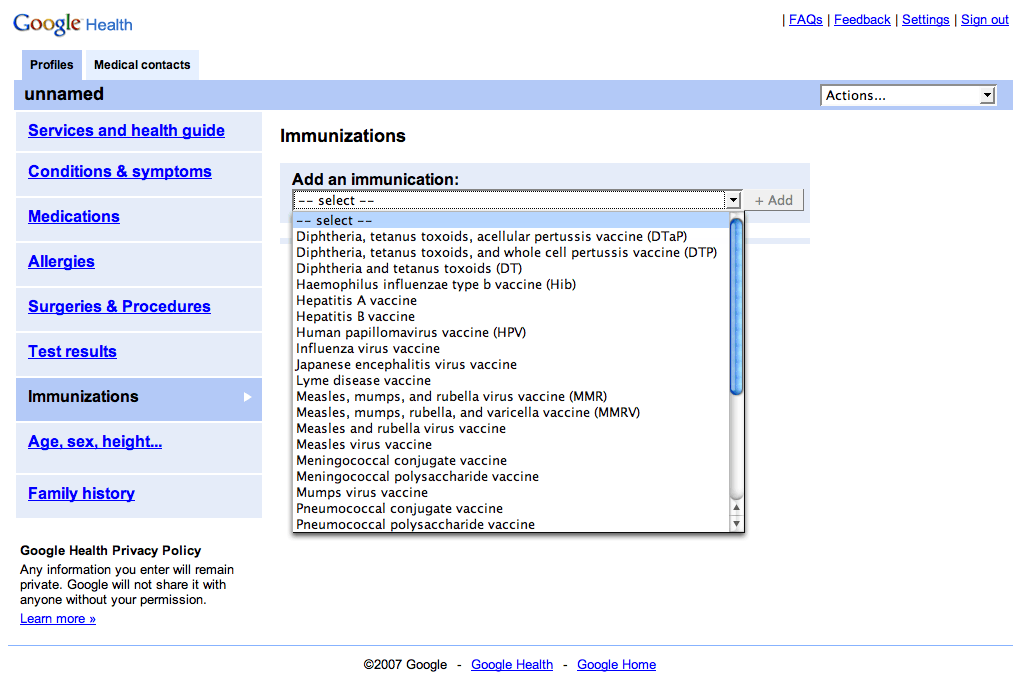

Part III: Understanding how to Develop Applications with HealthVault
Microsoft's HealthVault is not a "PHR" but rather a "PHR platform" with a set of back-end services for secure storage, retrieval and sharing of healthcare information. These services can be used by a developer to actually build what we may describe as a "classic PHR".
What does HealtVautlt mean to me as a developer? How does it work?
Here is the scenario as I see it, which explains how a developer may start to think of ways to use HealthVault:
Developing with HealthVault
- Lets assume a patient, John Doe registers for a HealthVault account. This is where his healthcare data would be stored. John Doe controls access to this data using his "Windows Live ID" credentials (user-name and password).
- Now suppose, I as a developer create a new PHR product called "Acme PHR" using HealthVault on the backend. That is, I develop the presentation layer, the actual website with my company's logo etc. I decide the look and feel of the application and the type of data I want want to collect and store for a patient. Additionally, I would also develop the business layer containing the business rules, knowledge-base and decision support functionality.
The final Acme PHR product is my company's application. The application performs the functions that I want it to perform. I can do interesting things with the application by combining the data in HealthVault with additional data that I define and store separately on my own server/database.
Designing a new HealthVault-based application- Personal Diet Planner and PHR
What do I mean by combining HealthVault data with my own defined data? Lets take an example. Suppose I want my PHR application to have the ability to provide different diets for patients with various health conditions, like diabetes, hypertension or obesity.
With my PHR, I will want to collect patient data such as weight, blood pressure, health conditions, blood sugar values, cholesterol results etc. This data is patient specific, so I decide to use HealthVault as the storage mechanism. Besides the convenience of using HealthVault's APIs, the big advantage of HealthVault is that it handles all the security issues, such as authorization and role based access to data (specified by the patient).
The database of the different diet plans however is stored on my company's servers. It is my company's proprietary data and would be kept entirely separate from HealthVault's data.
With my application, I can combine patient specific data from HealthVault, with my database of diet plans. So if a patient using my PHR, has high blood pressure and is obese, I may recommend a particular diet plan, while someone with just mild obesity, may get another diet recommendation. This is my application's "secret sauce", the ability to decide the proper diet for specific health conditions.
This is an important point, because my application is not about the details of storage and retrieval of health data, but rather, on how I use this patient's specific data and combine it with other data to create new innovative personal healthcare applications. This is much like an operating system. HealthVault essentially acts as an operating system like Windows, handling all the low level detail and chores, while my application focuses on the big picture.
Whats next? More Applications using common HealthVault Data
So patient John Doe uses my "Acme PHR" (with the special diet plan feature), and has entered his health data. John Doe is very happy with my PHR product.
But now, another company creates another product using HealthVault which recommends exercise plans for patients with specific health conditions. John Doe likes this idea. He has all his data already entered via my PHR product and is happy with the diet plan. He now wants exercise recommendations. John Doe can subscribe to this new "Exercise Planner" application. Fortunately, because it too uses HealthVault, John's data is already entered. This data can now be used by this new application. So using John Doe's existing weight, blood pressure and health condition data, an exercise plan can be recommended by this new product. There can be other products which do other things. The possibilities are endless.
HealthVault is like an Operating System
You can see the tremendous advantage of having personal health data stored once, with the ability to use it in multiple ways with disparate products. Just as the Windows operating system has resulted in countless software products, HealthVault likewise may lead to countless health care applications.
What does HealtVautlt mean to me as a developer? How does it work?
Here is the scenario as I see it, which explains how a developer may start to think of ways to use HealthVault:
Developing with HealthVault
- Lets assume a patient, John Doe registers for a HealthVault account. This is where his healthcare data would be stored. John Doe controls access to this data using his "Windows Live ID" credentials (user-name and password).
- Now suppose, I as a developer create a new PHR product called "Acme PHR" using HealthVault on the backend. That is, I develop the presentation layer, the actual website with my company's logo etc. I decide the look and feel of the application and the type of data I want want to collect and store for a patient. Additionally, I would also develop the business layer containing the business rules, knowledge-base and decision support functionality.
The final Acme PHR product is my company's application. The application performs the functions that I want it to perform. I can do interesting things with the application by combining the data in HealthVault with additional data that I define and store separately on my own server/database.
Designing a new HealthVault-based application- Personal Diet Planner and PHR
What do I mean by combining HealthVault data with my own defined data? Lets take an example. Suppose I want my PHR application to have the ability to provide different diets for patients with various health conditions, like diabetes, hypertension or obesity.
With my PHR, I will want to collect patient data such as weight, blood pressure, health conditions, blood sugar values, cholesterol results etc. This data is patient specific, so I decide to use HealthVault as the storage mechanism. Besides the convenience of using HealthVault's APIs, the big advantage of HealthVault is that it handles all the security issues, such as authorization and role based access to data (specified by the patient).
The database of the different diet plans however is stored on my company's servers. It is my company's proprietary data and would be kept entirely separate from HealthVault's data.
With my application, I can combine patient specific data from HealthVault, with my database of diet plans. So if a patient using my PHR, has high blood pressure and is obese, I may recommend a particular diet plan, while someone with just mild obesity, may get another diet recommendation. This is my application's "secret sauce", the ability to decide the proper diet for specific health conditions.
This is an important point, because my application is not about the details of storage and retrieval of health data, but rather, on how I use this patient's specific data and combine it with other data to create new innovative personal healthcare applications. This is much like an operating system. HealthVault essentially acts as an operating system like Windows, handling all the low level detail and chores, while my application focuses on the big picture.
Whats next? More Applications using common HealthVault Data
So patient John Doe uses my "Acme PHR" (with the special diet plan feature), and has entered his health data. John Doe is very happy with my PHR product.
But now, another company creates another product using HealthVault which recommends exercise plans for patients with specific health conditions. John Doe likes this idea. He has all his data already entered via my PHR product and is happy with the diet plan. He now wants exercise recommendations. John Doe can subscribe to this new "Exercise Planner" application. Fortunately, because it too uses HealthVault, John's data is already entered. This data can now be used by this new application. So using John Doe's existing weight, blood pressure and health condition data, an exercise plan can be recommended by this new product. There can be other products which do other things. The possibilities are endless.
HealthVault is like an Operating System
You can see the tremendous advantage of having personal health data stored once, with the ability to use it in multiple ways with disparate products. Just as the Windows operating system has resulted in countless software products, HealthVault likewise may lead to countless health care applications.
Friday, October 5, 2007
PHRs, too much Hype?
HIStalk's comments on HealthVault were very insightful as usual. I think the industry is a little too high on the concept of PHR. As HISTalk hinted, I do doubt most patients want to manage the details of their own health records. Much the same way that most of us would rather have Fidelity manage our 401Ks than having to try controlling every fund and stock within the account ourselves. That being said, under the right circumstances, I believe a PHR can complement a physicians own record keeping.
Part II. Microsoft's new HealthValult, More thoughts
I had more time to look at Microsoft's HealthVault. As I mentioned in my last post, after creating my own personal account, I was disappointed by the sparseness of what I saw. There was no place for me to enter my past medical history, medication lists or allergies. As a physician and a software developer, I must admit, I was confused by what I saw. It was not entirely obvious from the look and feel as to what the application really does.
I was hoping for a robust PHR. In fact, I was hoping to start signing up my patients for accounts as they presented for their appointments. However, if I found the application confusing, it would be pointless trying enroll my patients at this point.
I looked up all the available information on HealthVault from the Microsoft site. Because of my experience in developing healthcare applications, I believe I have a fair understanding of this application now. However, for many, I believe the application is a bit obtuse. I think it's fair to say, HealthVault, despite a barrage of news in the popular media, is not quite ready for direct patient use.
I do remain excited by this offering despite my early disappointment. Having a large company like Microsoft leading this effort, I believe there will be more opportunities for independent developers to create new healthcare applications. I know many think Microsoft is trying to "take over" healthcare, but I'm trying to take the positive view. We'll just have to wait and see.
More on HealthVault later...
I was hoping for a robust PHR. In fact, I was hoping to start signing up my patients for accounts as they presented for their appointments. However, if I found the application confusing, it would be pointless trying enroll my patients at this point.
I looked up all the available information on HealthVault from the Microsoft site. Because of my experience in developing healthcare applications, I believe I have a fair understanding of this application now. However, for many, I believe the application is a bit obtuse. I think it's fair to say, HealthVault, despite a barrage of news in the popular media, is not quite ready for direct patient use.
I do remain excited by this offering despite my early disappointment. Having a large company like Microsoft leading this effort, I believe there will be more opportunities for independent developers to create new healthcare applications. I know many think Microsoft is trying to "take over" healthcare, but I'm trying to take the positive view. We'll just have to wait and see.
More on HealthVault later...
Thursday, October 4, 2007
Microsoft's new Health Valult, a PHR?
I received notification about this new offering by Microsoft, "Health Vault". Dr Crounse, Worldwide Health Director for the Microsoft, writes about it in his blog.
As a practicing physician, I'm really excited about this application and have signed up for a personal account. My plan is to start enrolling my patients with the hope of consolidating their medical data.
I found however that the application did not have a place for me to enter my past medical history, medication lists etc. I think, for this application to work for my patients, this feature needs to be in place. Perhaps this feature already exists. If this is the case, it needs to be more obvious to the user. I know this is in beta, so I'm willing to wait. My hope is that the Health Vault is a true PHR.
There is an interesting integration feature. I can fax documents to my patient's account using a fax subscription service that converts the faxed document to a PDF file for storage in the patient's Health Vault. The patient must subscribe to the service. The cost is very reasonable however.
I will write more about the HealthVault as I discover more of its features.
As a practicing physician, I'm really excited about this application and have signed up for a personal account. My plan is to start enrolling my patients with the hope of consolidating their medical data.
I found however that the application did not have a place for me to enter my past medical history, medication lists etc. I think, for this application to work for my patients, this feature needs to be in place. Perhaps this feature already exists. If this is the case, it needs to be more obvious to the user. I know this is in beta, so I'm willing to wait. My hope is that the Health Vault is a true PHR.
There is an interesting integration feature. I can fax documents to my patient's account using a fax subscription service that converts the faxed document to a PDF file for storage in the patient's Health Vault. The patient must subscribe to the service. The cost is very reasonable however.
I will write more about the HealthVault as I discover more of its features.
Subscribe to:
Posts (Atom)


